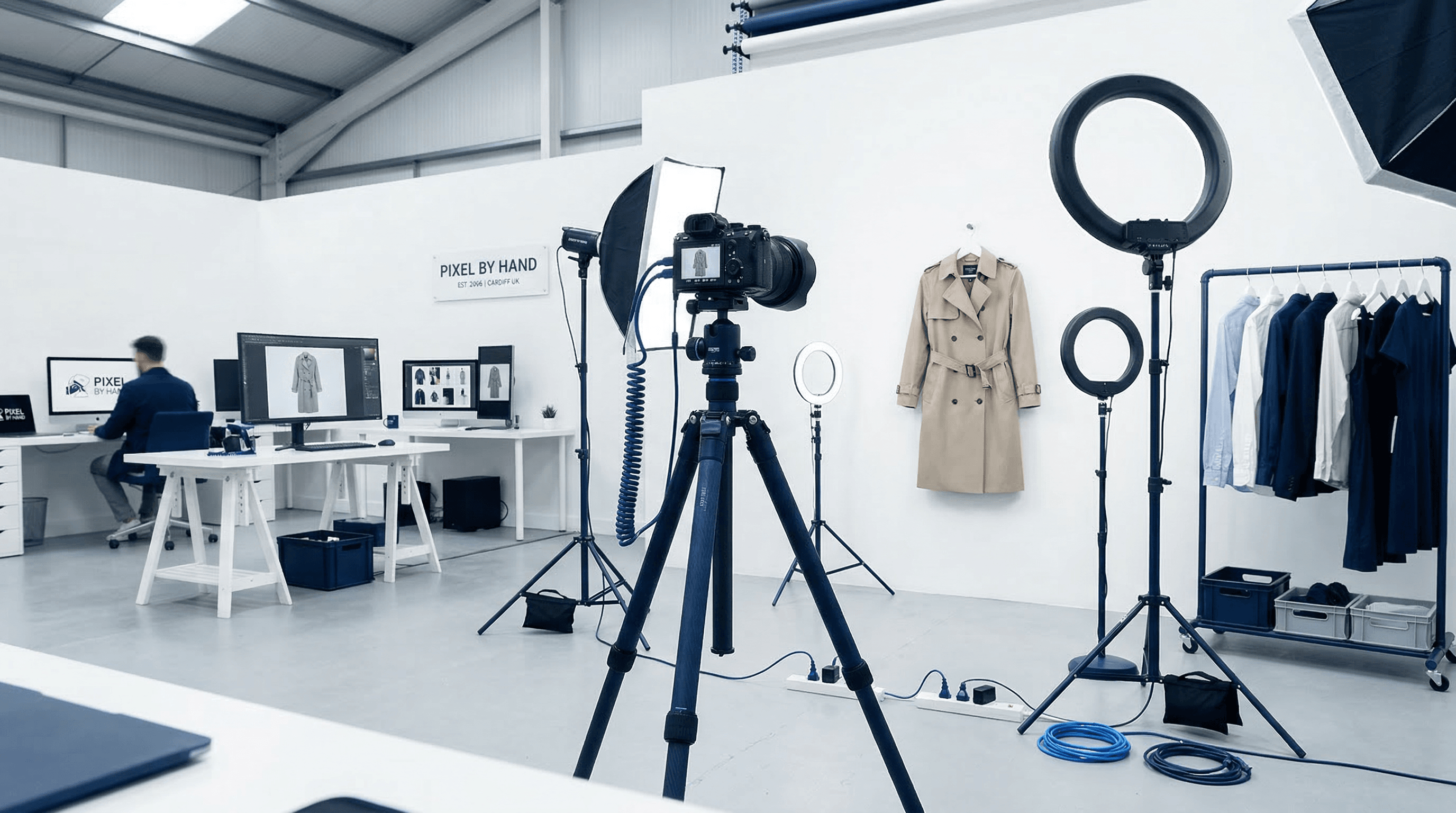
eCommerce Photography Trends 2026: The Definitive Guide to Selling More with Better Images
Product photography has always mattered in eCommerce — but in 2026, it is the single biggest lever you can pull to increase conversions, reduce returns, and build brand trust. With AI-powered editing tools, augmented reality try-on, immersive 3D imagery, and a cultural shift towards authenticity, the gap between brands that invest in their visuals and those that don't has never been wider.
At Pixel By Hand, we have spent more than a decade editing product images for over 380 eCommerce businesses worldwide. This guide distils everything we are seeing on the ground right now — the trends that are actually moving the needle, not just generating buzz.
Table of Contents
- Why Photography Trends Matter More Than Ever
- Trends at a Glance — Summary Table
- AI-Driven Photo Editing and Retouching
- Authenticity and the Rise of Natural Imagery
- Immersive Photography: 360-Degree, 3D and Video
- Augmented Reality and Virtual Try-On
- Mobile-First Product Photography
- Sustainability and Environmental Imagery
- Personalisation and Dynamic Visuals
- Fashion Retouching: From Airbrushed to Authentic
- Colour, Mood and Aesthetic Trends
- Minimalism and Lifestyle Photography
- The Business Case: Stats That Prove Visuals Sell
- How to Stay Ahead Without Doing It All Yourself
- FAQ
1. Why Photography Trends Matter More Than Ever
Global eCommerce sales surpassed $6 trillion in 2025 and are still climbing. In a market this crowded, your product images are often the first — and sometimes the only — impression a shopper gets before deciding to buy.
Trends are not about chasing fads. They signal shifts in consumer expectations. When shoppers start expecting 360-degree product views because Amazon and ASOS offer them, a flat-lay on a white background suddenly feels dated. When social media feeds reward authentic, candid imagery, an over-retouched hero shot can actually hurt your brand.
Staying current with photography trends is about meeting your customers where they are — visually and emotionally.
2. Trends at a Glance
| Trend | Impact Level | Adoption Difficulty | Who Benefits Most |
|---|---|---|---|
| AI-driven editing | High | Low | All eCommerce sellers |
| Authenticity / natural imagery | High | Low | Fashion, beauty, lifestyle |
| 360-degree / 3D photography | High | Medium | Furniture, electronics, fashion |
| AR and virtual try-on | Very High | High | Fashion, eyewear, home decor |
| Mobile-first optimisation | High | Low | All eCommerce sellers |
| Sustainability imagery | Medium | Low | Outdoor, fashion, food |
| Personalised / dynamic visuals | Medium | Medium–High | Large catalogues, fashion |
| Video and motion content | High | Medium | All eCommerce sellers |
| Minimalist product photography | Medium | Low | Tech, luxury, beauty |
| Lifestyle photography | High | Medium | Fashion, home, food |
| Monochromatic / moody aesthetics | Medium | Low | Fashion, beauty, luxury |
| Retro and vintage looks | Low–Medium | Low | Fashion, accessories |
3. AI-Driven Photo Editing and Retouching
Artificial intelligence has moved from novelty to necessity in product photography. In 2026, AI touches virtually every stage of the editing workflow:
- Automated background removal and replacement — What once took a skilled editor 10–15 minutes per image can now be initiated in seconds, with AI handling clean cut-outs and generating contextual backgrounds.
- Intelligent colour correction — AI analyses the scene and applies corrections that maintain true-to-life colour accuracy, which is critical for reducing returns.
- Skin and texture retouching — Tools like Adobe Sensei and Skylum Luminar use machine learning to smooth skin while preserving natural texture — pores, freckles, and all.
- Batch consistency — AI ensures that lighting, white balance, and cropping remain uniform across hundreds or thousands of SKUs, which is essential for marketplace compliance.
- Generative fills and extensions — Need to extend a background or add a shadow? Generative AI can do this convincingly, saving hours of manual compositing.
The human element still matters
AI is extraordinary at speed and consistency, but it struggles with creative judgement. Knowing how much retouching to apply, ensuring a garment's drape looks correct, or matching a brand's specific aesthetic — these still require an experienced human eye. The best results in 2026 come from AI-assisted, human-reviewed workflows, which is exactly how we work at Pixel By Hand.
Ready to see the difference? Send us your images for a free sample edit — no obligation, no credit card.
4. Authenticity and the Rise of Natural Imagery
The trend away from heavy retouching has been building for years, but in 2026 it has become the default expectation. Consumers — particularly Gen Z and millennial shoppers — actively distrust images that look overly polished.
What authenticity looks like in practice
- Minimal skin retouching — Frequency separation and dodge-and-burn techniques are used for subtle refinement, not to erase every natural feature. Freckles, wrinkles, and moles stay visible.
- True-to-colour editing — Editors focus on ensuring that colours on screen match the physical product. This reduces returns and builds trust.
- Candid and lifestyle shots — Rather than rigid poses against white backgrounds, brands are investing in images that show products being used in real-life settings.
- The "unedited" aesthetic — Slightly imperfect lighting, natural shadows, and visible texture signal honesty to the viewer.
This does not mean lower quality. It means higher-quality editing applied with restraint. The skill is in knowing what to enhance and what to leave alone — and that takes experience.
Why it matters commercially
Brands that embrace authentic imagery see higher engagement on social media, stronger click-through rates in advertising, and — crucially — fewer returns because customers know exactly what they are getting.
5. Immersive Photography: 360-Degree, 3D and Video
Static images are no longer enough. In 2026, shoppers expect to interact with product visuals:
360-degree photography
Once considered cutting-edge, 360-degree spins are now standard on major marketplaces including Amazon, ASOS, and Zalando. They allow customers to rotate a product and inspect it from every angle, replicating the in-store experience. Products with 360-degree views see significantly higher interaction rates and lower return rates.
3D product renders
For categories like furniture, electronics, and footwear, 3D renders are increasingly replacing traditional photography. A single 3D model can generate unlimited angles, colourways, and contextual scenes — without booking a studio or shipping samples.
Video content
Video has overtaken static imagery as the dominant content format across social platforms. Product videos — whether short-form demos, stop-motion sequences, or cinematic brand films — give customers a richer understanding of what they are buying.
The key for eCommerce brands is to integrate motion content alongside still photography, not replace it. Your product listing still needs crisp, clean stills for the primary image slots, with video and 360-degree views as supporting assets.
6. Augmented Reality and Virtual Try-On
AR has crossed the threshold from gimmick to genuine conversion driver. In 2026:
- Fashion and eyewear — Virtual try-on powered by smartphone cameras lets shoppers see how clothes, sunglasses, or jewellery look on them before buying.
- Home furnishings — AR room placement (pioneered by IKEA Place) allows customers to visualise a sofa or table in their own living space.
- Beauty — Virtual makeup try-on is now table stakes for any major cosmetics brand selling online.
What this means for your photography
AR experiences are built on top of high-quality product imagery — typically isolated product shots on transparent backgrounds or detailed 3D models. Investing in clean, accurate base photography now positions your brand to adopt AR features as the technology becomes more accessible to mid-market sellers.
7. Mobile-First Product Photography
Over 70% of eCommerce traffic now comes from mobile devices. Yet many brands still shoot and edit for desktop viewing first. In 2026, mobile-first is not optional — it is essential.
Practical implications
- Vertical and square formats — Mobile screens favour portrait-oriented or square images. Plan your compositions accordingly.
- Larger subjects, tighter crops — On a small screen, negative space is wasted space. Product images need to fill the frame.
- Fast loading — Compress images intelligently. A beautiful hero image that takes four seconds to load on 4G is a conversion killer.
- Thumb-friendly interaction — If you use zoom or 360-degree views, ensure they work smoothly with touch gestures.
Smartphone photography has levelled the playing field
The cameras in flagship smartphones now rival DSLRs for product photography in many scenarios. This is a boon for small businesses and start-ups that lack the budget for professional studio equipment. Combined with professional post-production from a service like Pixel By Hand, smartphone-shot images can look every bit as polished as those from a full studio setup.
8. Sustainability and Environmental Imagery
Consumers increasingly choose brands that align with their values — and sustainability is at the top of the list. This has created a distinct visual trend:
- Natural settings as backdrops — Products photographed outdoors, in forests, on beaches, or in sunlit spaces signal an eco-conscious brand ethos.
- Raw, unprocessed materials — Close-up texture shots of recycled fabrics, natural wood, or handmade elements communicate quality and environmental responsibility.
- Packaging as a story — Brands are photographing their sustainable packaging with as much care as the product itself.
Environmental product photography works because it is authentic storytelling, not marketing spin. Outdoor apparel brands like Patagonia have led the way, but this approach now extends to furniture, food, beauty, and fashion.
9. Personalisation and Dynamic Visuals
In 2026, the smartest eCommerce platforms serve different images to different customers based on their browsing behaviour, location, and preferences:
- Dynamic hero images — A returning customer might see the colourway they previously viewed, while a new visitor sees the best-seller.
- AI-generated contextual scenes — The same product can be shown in a minimalist apartment for one audience segment and a rustic kitchen for another.
- Personalised recommendations with visual consistency — When your "you might also like" section uses cohesive, high-quality imagery, click-through rates climb.
This trend is powered by the intersection of AI, customer data, and a large library of professionally edited product images. The brands that invest in building a deep, versatile image library now will be best positioned to leverage personalisation as the tools mature.
10. Fashion Retouching: From Airbrushed to Authentic
Fashion retouching has undergone a philosophical shift. The heavy airbrushing and body manipulation of the past is giving way to a more responsible approach:
What is changing
- Ethical retouching standards — Many brands and marketplaces now have explicit policies limiting the extent of body and skin retouching.
- Diversity in representation — Images feature a wider range of body types, skin tones, and ages, which requires retouching that enhances rather than homogenises.
- Technique over transformation — Advanced techniques like frequency separation and dodge-and-burn are used to refine lighting and texture without altering the model's natural appearance.
What remains essential
- Colour accuracy — Garments must match their real-world counterparts on screen.
- Wrinkle and crease management — Removing distracting fabric creases (not body features) ensures the product looks its best.
- Consistent lighting across a collection — Whether a lookbook or marketplace listing, every image in a set should feel cohesive.
Direct flash, dark and moody, and candid styles
These aesthetic directions — direct flash for bold, high-contrast impact; dark and moody tones for editorial storytelling; candid moments for relatability — are all thriving in 2026 fashion photography. The common thread is that they require skilled post-production to look intentional rather than accidental.
11. Colour, Mood and Aesthetic Trends
Visual trends in 2026 span a wide spectrum, giving brands plenty of room to find their own identity:
Vibrant colours and gradients
Bold, saturated palettes — electric blues, sunset oranges, deep purples — grab attention in crowded feeds. Gradient backgrounds are particularly popular for hero images and social media assets.
Monochromatic schemes
Using a single colour in varying shades creates a sophisticated, focused aesthetic. Cosmetics and tech brands use this to great effect, lending images a sense of luxury and intentionality.
Retro and vintage aesthetics
The 70s revival continues, with warm film-grain tones, muted highlights, and nostalgic colour grading. AI tools make it easier than ever to apply these effects consistently across a catalogue.
Dark and moody
Deep shadows, rich blacks, and desaturated tones create drama and emotional depth. This style works particularly well for editorial fashion and premium products.
The key takeaway: choose an aesthetic that aligns with your brand identity and apply it consistently. Inconsistency across your product catalogue is more damaging than choosing the "wrong" trend.
12. Minimalism and Lifestyle Photography
These two approaches sit at opposite ends of the spectrum, but both are essential in 2026:
Minimalism
- Clean, uncluttered compositions on simple backgrounds
- Strategic use of negative space to draw the eye to the product
- Particularly effective for tech, luxury, and beauty products
- Apple remains the gold standard, but the approach works at every price point
Lifestyle photography
- Products shown in real-world contexts — on a kitchen counter, in a living room, being worn on the street
- Helps customers envision the product in their own lives
- Creates emotional connection and supports social media storytelling
- Brands like IKEA, Anthropologie, and ASOS excel at this
The most effective eCommerce brands use both — minimalist hero images for the main product listing, supported by lifestyle shots that tell the broader story.
Want to see how professional editing transforms your product shots? Start your free trial — send us a selection of images and we will show you what is possible.
13. The Business Case: Stats That Prove Visuals Sell
If you need to justify investment in better product photography, the numbers speak for themselves:
- Content paired with images receives 94% more views than text-only content.
- 93% of the most engaging social media posts include images.
- Products with multiple images, 360-degree views, or video see significantly higher conversion rates than those with a single photo.
- 65% of people are primarily visual learners — images communicate faster than text.
- 80% of marketers use visual assets as a core part of their social media strategy.
- High-quality, accurate product images directly reduce return rates, which protects your margins.
In short: better images mean more clicks, more conversions, fewer returns, and stronger brand loyalty.
14. How to Stay Ahead Without Doing It All Yourself
Keeping pace with every trend is not realistic for most eCommerce businesses — nor is it necessary. Here is a practical approach:
- Nail the basics first — Clean, well-lit, colour-accurate images on white or neutral backgrounds. This is your foundation.
- Add lifestyle and contextual shots — Even a few per collection make a significant difference to engagement.
- Optimise for mobile — Review every image on a phone screen before publishing.
- Outsource your post-production — Professional editing is where the biggest quality leap happens, and it is far more cost-effective than hiring in-house. Services like Pixel By Hand handle background removal, colour correction, retouching, and formatting for every major marketplace.
- Test one new trend per quarter — 360-degree views, short-form video, or AR-ready assets. Measure the impact before scaling.
With over 10 years of experience and more than 380 eCommerce clients, Pixel By Hand exists to make your products look their absolute best — without you needing to become a photography expert.
Ready to get started? Send us your images for a free sample edit — completely free, no strings attached. See the difference professional editing makes for your brand.
15. Frequently Asked Questions
What are the most important ecommerce photography trends in 2026?
The biggest trends are AI-driven editing workflows, authentic and minimally retouched imagery, 360-degree and 3D product views, mobile-first optimisation, and augmented reality try-on experiences. Of these, ensuring your images are mobile-optimised and colour-accurate delivers the fastest ROI for most businesses.
Will AI replace professional photo editors?
AI is a powerful tool for speed and consistency, but it does not replace the creative judgement and quality control that experienced editors provide. The best results come from AI-assisted workflows reviewed by human professionals — which is how leading editing services operate in 2026.
How important is 360-degree photography for my online store?
It depends on your product category. For furniture, electronics, footwear, and fashion, 360-degree views are increasingly expected by shoppers and correlate with higher conversion rates and lower returns. For smaller or simpler products, high-quality multi-angle stills may be sufficient.
Do I need to invest in AR for my eCommerce business right now?
For most mid-market businesses, AR is still a "nice to have" rather than a "must have" in 2026. However, investing in clean, high-resolution product photography on transparent backgrounds positions you to adopt AR features as the technology becomes more accessible. Think of it as future-proofing your image library.
How can I make my product images more authentic without lowering quality?
Focus on true-to-colour editing, minimal skin retouching, natural lighting, and lifestyle contexts. Authenticity is not about lower production values — it is about restraint in post-production and honest representation of the product. A professional editing service can help you strike exactly the right balance.
How much does professional product photo editing cost?
Costs vary depending on the complexity of the edit and the volume of images. At Pixel By Hand, we offer flexible per-image pricing with volume discounts, and every new client starts with a free sample edit so you can see the quality before committing. Get in touch for a personalised quote.
This guide is maintained by Pixel By Hand — professional product image editing for eCommerce businesses worldwide. With 10+ years of experience and 380+ clients, we help brands turn good product photos into great ones.